
Myanmar the country of golden temples
Myanmar, also known as Burma, has just opened up to the world after a long embargo and isolated time. However, this is also the reason why Myanmar become the most attractive tourist destination in Southeast Asia.
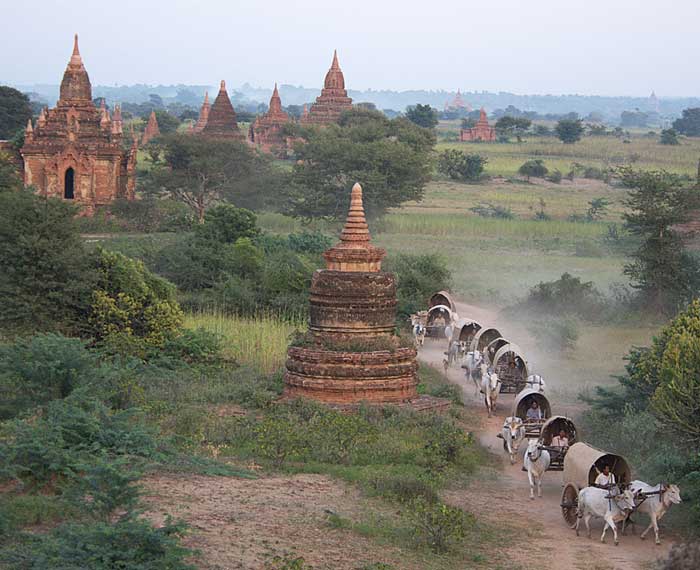
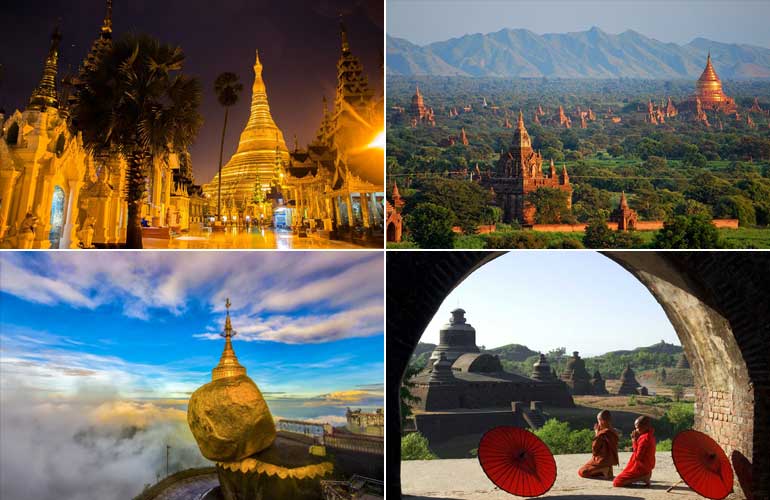
Myanmar is an ancient country with great and sophisticated religious relics both in terms of scale and architecture. For Example, the golden pagoda of Shwedagon in Yangon, the magic Kyaikhtiyo Golden Rock temple, or the complex of thousands monumental temples in Bagan. Take a Myanmar tour and see how beautiful it is with Myanmar Private Tour.
Famous temples in Myanmar
In addition, Myanmar tourism also attracts foreign visitors through the unspoiled and peaceful natural beauty of Inle Lake, Ngapali beach and the unique practices of the long-necked tribe Pa-O and Thanaka cream.
To better understand the culture of Myanmar, let’s explore things to see and do with us.
Geography in Myanmar
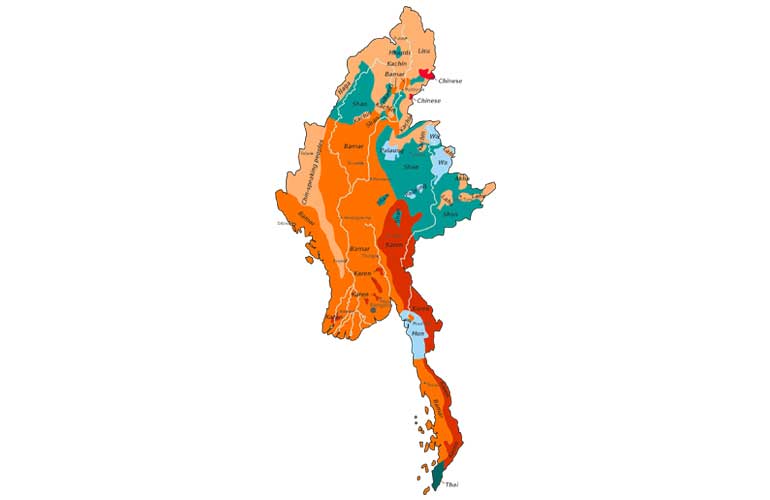
Myanmar is situated in the west of the Indochina Peninsula. Myanmar is 676,570 square kilometers in size - the largest in Southeast Asia, including 7 large states forming the Union of Myanmar, the population is over 57 million people in 2022 of 135 groups.
Map of Myanmar
Among them, Burmese account for 65%, and 85% of the population in Myanmar are Buddhist. The official language is a Burmese dialect. At the offices, English is also very popular. The most populous city is Rangoon (Yangon). The capital is Naypyidaw.
History in Myanmar
Tourists should learn something about the history before going to Myanmar. In 1044, King Arolong ruled Myanmar, and until 1287, the nation of Bangladesh was in power. From the 16th century until about 1826 – 1885, the British colonial occupied the whole of Myanmar.
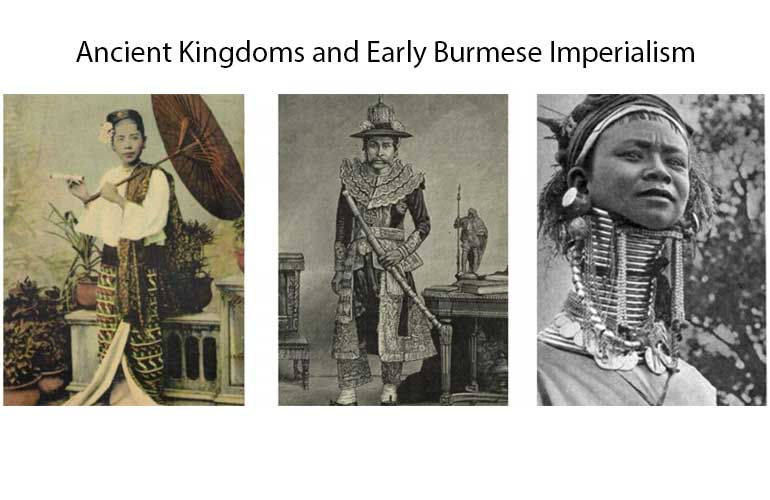
Ancient Kingdoms and Early Burmese Imperialism
Myanmar separated from Britain in 1948 and became an independent republic. In 1990, after multi-party elections, the military remained in power. In 1995, the rebellion of ethnic minorities ended in a ceasefire manner.
Religious in Myanmar
The majority of the Burmese are Buddhist: there’s at least a temple and a Buddhist monastery in any city or town. Buddhism has a great influence on the people of Myanmar, their life is associated with Buddhist rituals. Buddhist Lent is also on the calendar of Myanmar – three months in the rainy season, from July to October. During this period, people are vegetarian; marriage and house moving are often postponed.
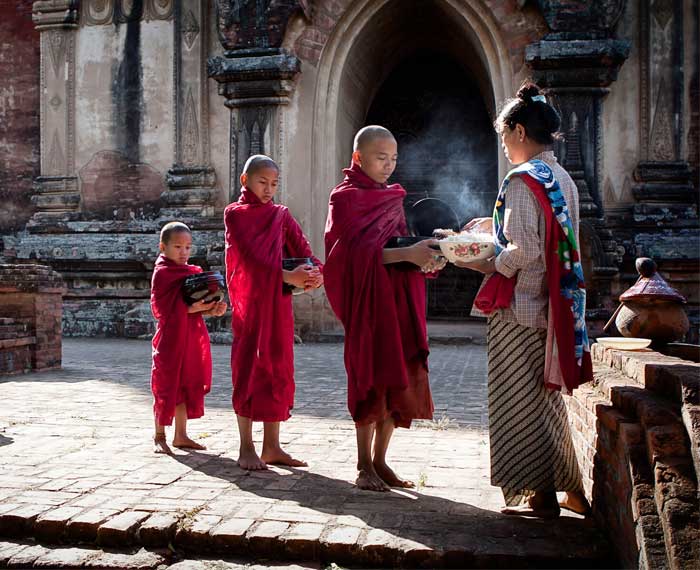
Among Buddhists in Myanmar, 99% are Burmese, Shan, and Karen people. They're about 500,000 monks and nuns in Myanmar. Buddhism in Burma is Theravada (literally meaning: the "Smaller Vehicle"). The practice of the monks is nothing different from Buddhism in Thailand, Laos, Sri Lanka, and Cambodia, monks don’t live in temples but in the monastery, in the morning they collect alms on the street, they are non-vegetarian and only eat from sunrise to before 12 am.
From 12 am to the next morning, they absolutely can not eat.
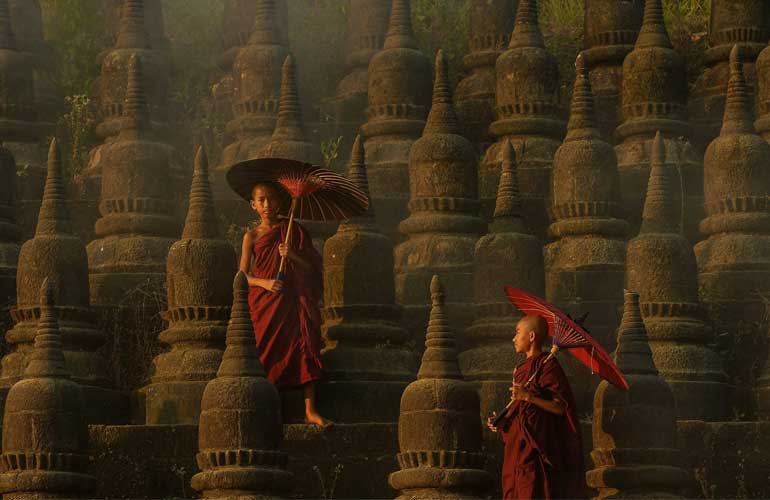
Young Monks
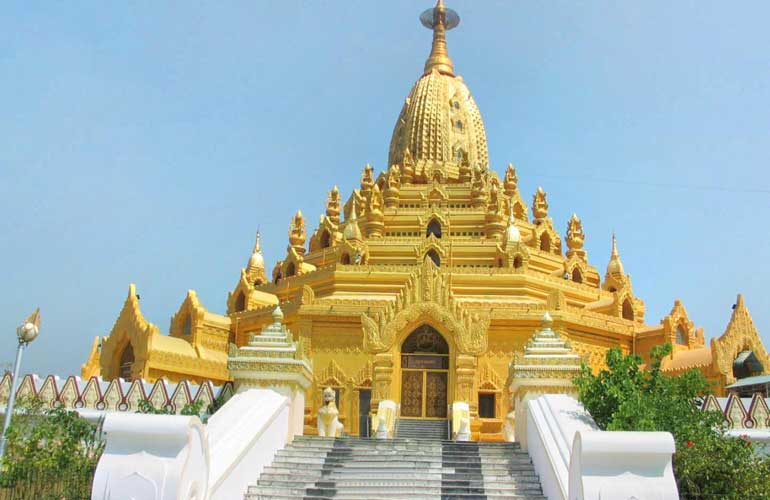
Swe Taw Myat Paya Pagoda
To get an ideal tour of Myanmar, you should also learn their custom:
Like Vietnamese meals, the main food of Myanmar people is rice besides meat, vegetables, shrimp, and fish. For the people of Myanmar, beef is taboo and rarely eaten. Especially, the Burmese don’t use chopsticks but their hands. At the end of the meal, they usually drink tea or eat some fruits, which is called dessert.
Typically, their food is quite dry, so perhaps it’s not suitable for your taste. To get delicious and more suitable food, you should go to Chinese and Thai restaurants. The famous dishes in Myanmar are Mohinga noodle soup, salad, curry, cakes, and pink young bamboo.
You definitely should enjoy Mohinga because it is considered the national dish of the country, made from noodles and fish soup, served with fried vegetables, and fried beans, and often eaten at breakfast.
If Myanmar is interesting enough to you, why don’t you take your bag and fly to this peaceful country, enjoy tranquil moments, and give yourself the most memorable trip of your lifetime?
Famous destinations
Shwedagon, also known as Golden Temple in Yangon, is the largest and most beautiful one in Myanmar, formed 2500 years ago, and was extended gradually by several feudal dynasties.
Shwedagon Temple is located on a big hill, top of the tower is attached to a lot of diamonds, rubies, jade, and precious stones. The temple is gilded so it’s always sparkling in the sunshine during the day and electric light at night.
There are many famous temples: Chauk Htat Gyi – the reclining Buddha temple, Jade Buddha temple, Sule – where Buddha’s hairs are kept, Swe Taw Myat Paya or Buddha tooth relic pagoda.
Visitors going to Myanmar will have a chance to discover many temples with different architecture.
Kyaikhtiyo temple in Mon state is a unique wonder of the world. The temple was built on a large yellow rock protruding from the high cliff - it looks very spectacular.
As a beautiful country with lots of scenic landscapes and ancient culture, Myanmar is one of the most attractive countries in Southeast Asia and also a popular destination for tourists worldwide.
Ngapali Beach
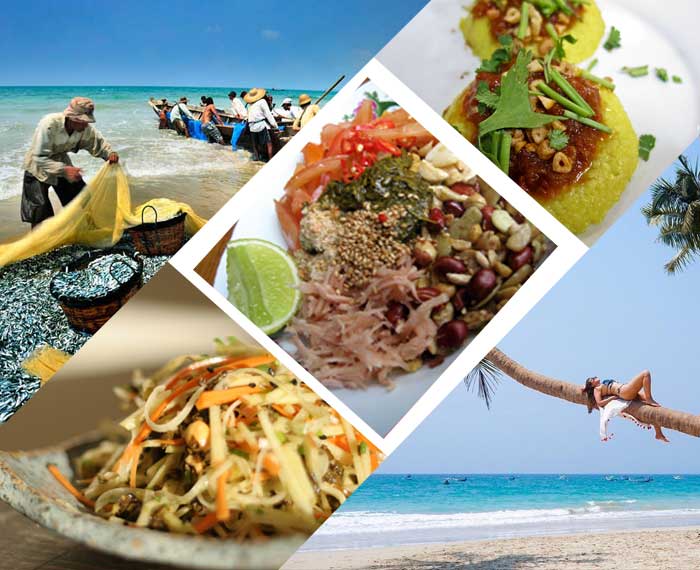
Ngapali Beach is one of the most famous destinations in Myanmar and also the most beautiful beaches in the country. Ngapali is a beautiful sandy beach stretching over the Bay of Bengal. It lies about 7 km from Thandwe, Rakhine State. It is famous for its natural and unspoiled beauty.

Ngapali Beach
The beach stretches about 3 km with soft white sand under the shade of coconut trees. It offers beautiful natural scenery of blue sea, white sand and gentle sun. The water is blue platinum, clean without any dangerous marine animals.
The best time to enjoy Ngapali beach is from October to May. During this time, the beautiful blue sea with white sandy beaches captivates tourists who come to visit this place.
Visit Ramree – the Island of Death in Myanmar
Travel Myanmar – Long time ago, Ramree island in Myanmar has been dubbed "the island of death in the world" because of thousands of crocodiles existing. Because of the large number of crocodiles, people setting foot on this island must be cautious! You can easily become the bait of these ‘swamp murders’.
"Swamp murders" have become an obsession for all those who intend to set foot on this "aggressive" land by a true story associated with cold-blooded predators, making Ramree island - a caustic tale of horrors.

Ramree Island Myanmar
In 1945, after the war between the British and the Japanese army, nearly 1,000 Japanese soldiers withdrew into the marshes around the island and encountered giant saltwater crocodiles in the area. Only 20 people survived. Guinness Book recognized it as the "worst disaster caused by the animals."
Thus, with a large number of crocodiles, Ramree - Myanmar is classified as one of the most terrifying and dangerous islands in the world, even most adventurous travelers feel "TERROR” and "fear” when hearing the name world; even most adventurous travelers feels "shudder" and "creepy" when hearing the name of this obsessive island.
Visit the peaceful Pathein city
Explore The City Of The umbrella – Pathein.
Pathein is the capital city of the Ayeyarwady Region and the 4th largest city in Myanmar. The city is located on the Pathein river, to the west of Ayeyarwady Delta, and about 190 km from Yangon City. There are about 300,000 people, mostly Karen and Rakhine people.
City of the umbrella
There are about 300,000 people, who mostly are Karen and Rakhine people, with the Shwemokhtaw Paya pagoda built by King Asoka of India. A long time ago, the Pathein land was a part of the Mon kingdom; however, there are not many Mon people living here.
Pathein is known for its high-quality rice and colorful history in the colonial period. There is a picturesque waterfront and numerous exhibitions on the unique umbrella made from the hands of people in Pathein.
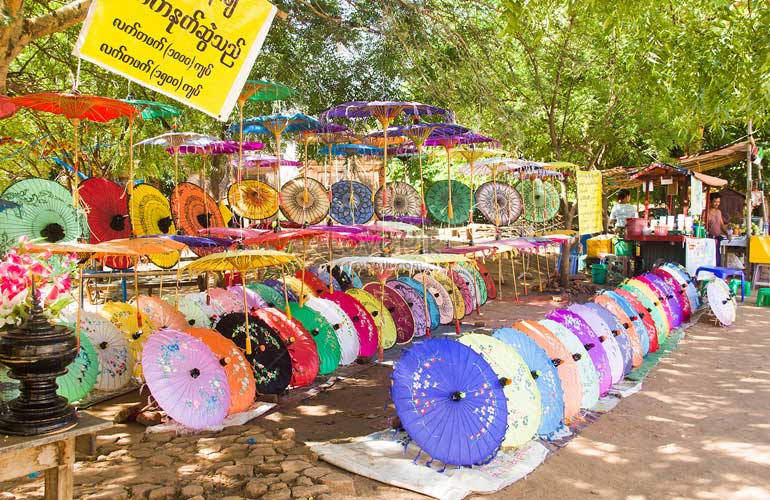
Oil-paper umbrella in Mandalay
The umbrellas, also known as Patheinhti or Pathein umbrella, are one of the symbols of the city. Most umbrellas are for sunny days, they cannot keep people from the rain. They are mainly made of wood, and even some silver details to increase the beauty and formality.
They are painted colorfully with many decorative motifs such as flowers, birds, and other natural textures, shapes, and elegant colors. Each umbrella is a picture with nuances and different emotions. Under brilliant sunshine, vivid pictures move across the city. Besides the umbrella for sunlight, in Pathein there’s also the vivid umbrella for rain. These umbrellas help the drivers have a better view when the storm hits the country. There are also different umbrellas for ages and genders.
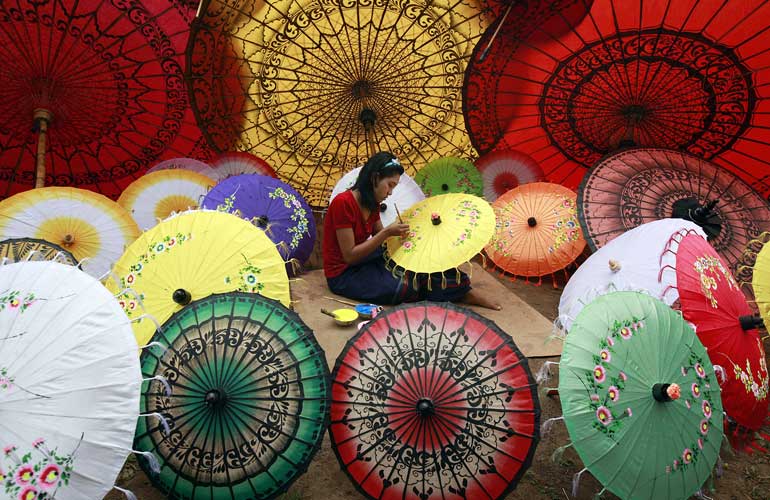
Mandalay umbrella maker
Children especially like funny cartoon character images. The girls liked subtle patterns like paintings or flowers. The men chose the dark-colored umbrella. The umbrella for the monks is dark brown or orange. The umbrella is made of different sizes according to the template available.
The average time to finish an umbrella is about 5 days. The prices of these Pathein umbrellas are very reasonable and even very cheap. Umbrella factories are located mainly in the north of the city and always welcome tourists to visit. Shwe Sar factory in No. 653 Tawya Kyaung Rd, nearby Settawyar temple is a famous workshop for many years.
Road to Pathein
The road trip from Yangon gives visitors a great serene feeling from the green paddy fields and fisheries along the roadside. Myanmar people in general, and in particular Pathein, eat betel pretty much. The elder, the youth, the men, the women ... everyone loves betel. Many roads are red, because of betel water.

Pathein Myanmar Overview
They also love to apply a layer of Thanaka on the cheek, probably to be beautiful, to avoid sunlight, or pray for good luck.
Previously, the Burmese often covered their house with thin layers of Pam wood. Besides ancient mansions, many wooden roof Pam still exists in the city of Pathein.
On the street, sometimes we will see military barracks and meet the soldiers patrolling.
More than 80% of Burmese follow Theravada Buddhism, and the temples worship only Shakyamuni Buddha.
Early in the morning, monks in brown or yellow robes, according to season, go through the streets to collect alms. In the afternoon, visitors will also see the nuns in pink collecting food on the streets.
Myanmar is a famous sacred land. No room for guests interested in recreational entertainment and enjoyment. Those who come here with all their goodwill will harvest a bumper crop of blessings.
The main attraction in this city is Shwemokhtaw Paya, built by King Asoka of India. There is also the Cultural Museum Pathein. Two universities, Pedagogical Pathein School and Pathein College, are located in this city.
A long time ago, Pathein land was a part of the Mon kingdom; however, there are not many Mon people living here.
Explore Ngapali Beach in Myanmar
Ngapali is the most beautiful beach in Myanmar. Located in Rakhine state, Ngapali has a smooth sandy beach stretching gracefully on the Bay of Bengal. The best time to enjoy Ngapali beach is from October to May. During this time, the beautiful blue sea with white sandy beaches captivates tourists who come to visit this place.
For those who have a romantic soul, in love with the pristine beauty and tranquility, Ngapali Beach is the most appropriate destination. Ngapali is the most famous beach in Myanmar, with the poetic beauty of sparkling white sand under brilliant sunshine, winding by lush green coconut lines. The coastline is about 7km long with beautiful turquoise waves.
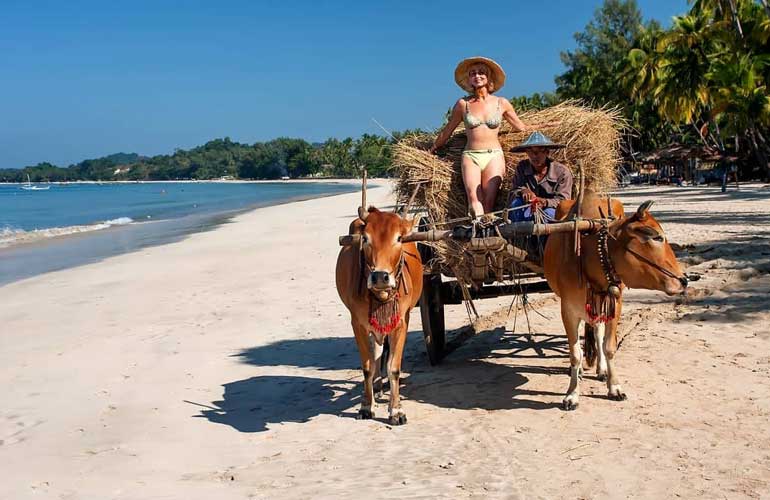
Explore Ngapali Beach in Myanmar
It is famous for its natural and unspoiled beauty. The beach stretches about 3 km with soft white sand under the shade of coconut trees. It offers beautiful natural scenery of blue sea, white sand and gentle sun. The water is emerald, clean, and without any dangerous marine animals. Ngapali also has abundant marine resources: shrimp, lobster, coral, and fish.
Besides swimming, walking, and exploring the surrounding natural landscape, you can also indulge in excursions such as visiting the small fishing villages and local markets or exploring the countryside by a small and convenient bike, or even a boat trip to the splendid islands off the coast, if your budget is abundant. In addition, visitors can learn many interesting things from the fancy golf on the beach.
When visiting the fishing village, you will feel the rustic and casual sounds from net trawling. Every morning, the sound of oxcarts carrying seafood to the local market is also very fascinating. Local people in the fishing village are very friendly, in addition, the simplicity of life in this land brings special tranquility to every traveler’s soul.
MYANMAR
Some Special Buddha Statues
Myanmar (Burma) is a country with a million tower temples. Burmese followed Theravada, so the temple’s facade would always be giant gilded bell towers. When Marco Polo visited Myanmar with a forest of golden temple towers, he called Myanmar the Land of Gold.
They're more than a million temples, so obviously, there must be millions of Buddhas.
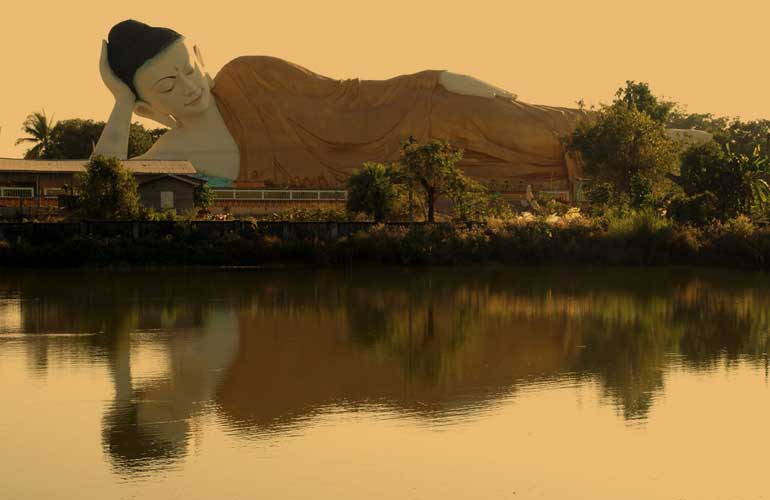
Special Buddha Statue
And of course, in these millions of statues, many statues express Buddhist philosophy, the life of Buddha and the other Buddhas: the life of Buddha from birth until nirvana, the previous lives of the Buddha, mudras of Buddha, sitting Buddha, reclining Buddha, semi-recumbent, standing Buddha, walking Buddha, etc ...
Below is just some Buddha statues with different exclusive characteristics that we luckily met.
Rejected Buddha
Shwedagon Pagoda is a national symbol in Yangon's former capital. It is considered the oldest pagoda in Myanmar, built 2,600 years ago.
The temple has four treasures of four main Buddha: Buddha Kakusandha’s scepter, Buddha Konagamana‘s water filter, a Buddha Kassapa’s piece of robe, and eight hairs of Gautama Buddha.
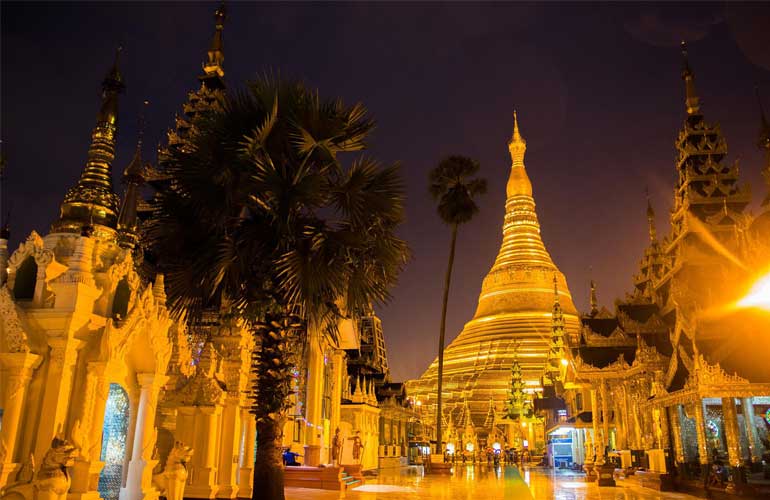
Shwedagon Pagoda
Shwe - means gold, and Dagon is the former name of Yangon.
In this temple, there is a very precious jade statue but the Burmese do not even give a look at it.
The reason is that this statue is the offering of a militarist general. The statue’s face looks similar to the general's!
Sweet-Eyed Buddha
Nearby the Golden temple of Shwedagon, there’s a temple named Chaukhtatgyi Paya, famous for its giant reclining Buddha statue. This is a special Buddha statue with the eyes open to look at the world. The eyes are blue and glittering.
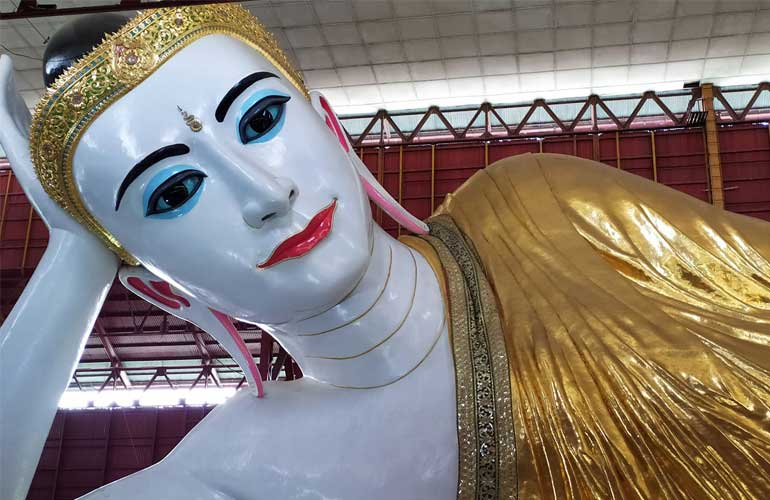
Sweet-Eyed Buddha
Buddha's eyes were made of crystal and offered by the most famous crystal manufacturing company.
Buddha Wearing Armor
Also, not far away from the reclining Buddha temple is a majestic seated Buddha statue - Ngadatkyi Paya.
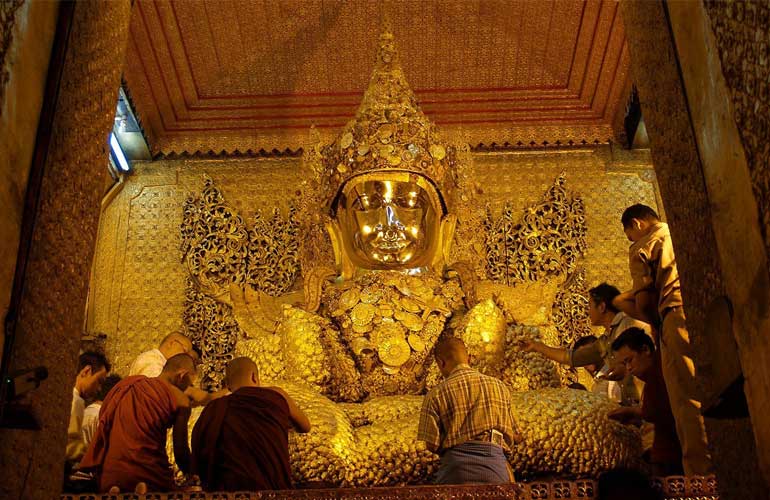
Buddha Wearing Armor
Especially this Buddha is dressed in gold, with gold shoulder and neck shields that look like gold armor. Because it was made by the military, there’s the golden armor. Dictators always have to wear armor, even IN their spiritual life.
That’s why the Burmese called this Buddha wearing armor.
Golden skin-toad Buddha
The Mahamuni temple is one of the most important Buddhist pilgrimage sites in Mandalay. The temple is famous for its golden Buddha image.
The statue is revered as an expression of the life of Buddha, made when he was alive. According to legend, the Buddha visited Dhaniyawani city in Arakan in 554 BC and king Sanda Thuriya asked his permission to make a statue. After completion, the Buddha consecrated and enlivened the image. That’s why it was called the Mahamuni Living Image.
Burmese and Buddhist devotees all over the world apply gold leaves to the image (except the face), which made the statue covered with a thick layer of gold leaf of about 15 centimeters.
Golden Buddha
In Inle lake, Shan State, there’s a famous temple named Phaung Dau Pagoda OO that has been known for years for the golden-block Buddha.
In the beginning, these Buddha images were nothing different from others; however, Buddhist devotees apply gold leaves to the images, making them now to no certain shapes anymore. The images become five golden blocks.
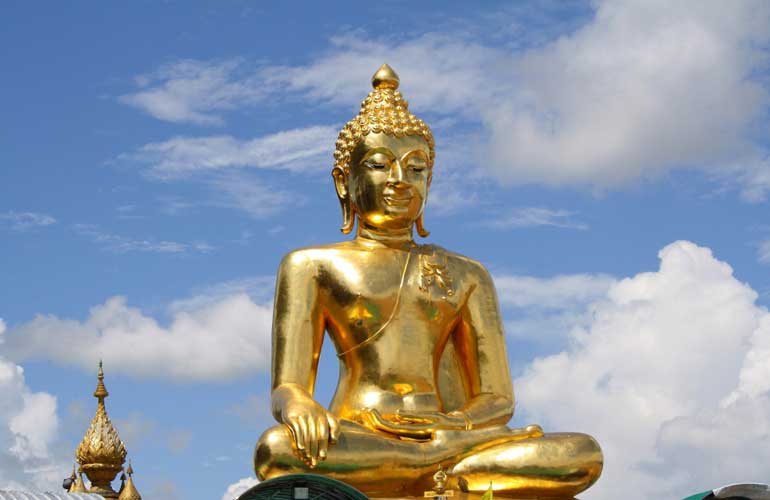
Golden Buddha
In October, they annually hold the festival procession in which the statues are put on a Yangon Hintha-bird-shaped boat. The boat goes around the lake clockwise (Buddhism is a static religion that inclines toward “YIN” so all Buddhist rituals move clockwise). Boats stop at some large villages. The statues are then transferred to the village temple to worship overnight. The next day they continue cruising.
In about 1960, when cruising on the lake, the boat accidentally sank because of a thunderstorm. The divers could only find four statues. Upon returning to the temple, people were surprised that the 5th statue was on the altar.
Since then, every year, people just bring four statues on the boat procession and leave a statue at the temple.
Sweating Buddha
Pindaya cave temple overlooking Inle Lake contains 8000 Buddha statues in various styles with different expressions, faces, noses, hair, posture, and clothes...
There are many legends about the temple. Among these, the most common is a local legend about a giant spider living in a cave. One day the spider captured seven princesses while they were bathing and held them captive in the cave. Kummabhaya, the prince of Yawnghwe, armed with a bow and arrow, killed the spider, thus rescuing the Princess. Then the cave was used as a temple afterward.
According to devotees’ faith, this is the spiritual vigor of Buddha exhaling. They often touch the statues and take the sweat drops with the hope that they will be blessed. Sometimes they apply the sweat to their head, face, or ill body to pray for good luck.
Other people explain that the “sweat” is derived from caves’ moisture only.
A notable thing is these two sweating statues are black. According to Jing, black symbols signify water. And water is a symbol of the Mother of Life.
Eating Buddha
In this Pindaya cave temple, there’s a special Buddha statue eating with his bare hand while looking at the sky, which looks very playful.
Buddha Holding seed
Also, in this cave, there’s a statue holding a seed, which refers to karma. The guide explained that this Buddha image is of a great doctor of humanity.
This image is not found in Theravada but in Mahayana. This point and the details of many other objects in the cave indicate the presence of Mahayana Buddhism in Myanmar. This is understandable because the Shan State shares a border with Yunnan and part of the Mekong river.
They speak Thai – Tay language and have connections with ancient Vietnamese, which is clearly seen through their worshipping and making of bronze drums. These Shan drums are used by Karen people, so often called Karen drums (see Shan Bronze Drum).
Lap-Holding Buddha
Shwezigon Temple in Bagan is famous for keeping the four teeth of Buddha.
Especially it’s also well known for a reclining Buddha holding a lap.
Buddhist devotees believe that if they can touch this lap, they will have a chance to return to Myanmar and revisit this statue. This caused a part of the sleeved shirt to threadbare and hence the statue is walled off.
Smiling Buddha
Ananda Temple in Bagan is one of the four oldest temples that still exist.
The temple was built in the Mon-Indian mixed architectural style. In the temple, are four statues overlooking the four directions? The Statue looking Southwards is Kassapa, Northwards is Kakusandha, Eastwards is Konagamana, and Westwards is the Gotama.
Captured Buddha
Manuha Temple is one of the oldest temples in Bagan, built-in 1067 by the Mon king prisoner Manuha. King Manuha in Thaton got Tripitaka - the sacred Buddhist scriptures. King Anawrahta wanted to have that scripture but Manuha refused. Then Anawrahta conquered and captured king Manuha in Bagan.
King Manuha was allowed to build a temple to practice. He built the temple that later was named after his name. The temple expressed grievances because of his detention. The temple has three seated images and a reclining one. The statues are all imprisoned in a narrow room-like cell.
Especially, the reclining Buddha, attaining nirvana though in captivity, still smiling, said to be the mood of the king Manuha: only he was released from captivity when he died.
Myanmar - The untouched beauty
Myanmar is also a country with a rich history and culture, with many immaculate values which can not be lost in modern life.
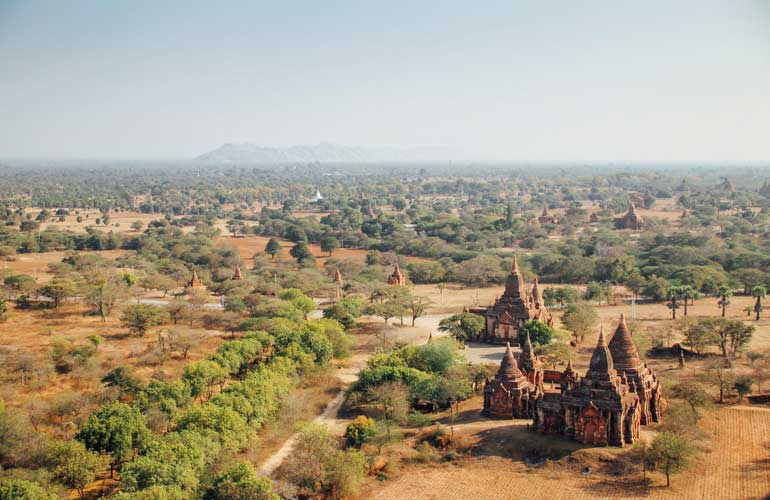
Myanmar - The untouched beauty
In particular, I do remember unique temples and the unique lifestyle of the Intha people, an ethnic group of Myanmar…
The unique temples
Shwedagon is the most famous temple in Myanmar. Although our guide had introduced some features of Vietnam, my friends and I were still astonished by the beauty of the temple.
The temple is 98m in height, consisting of 1,000 smaller temples surrounding it. Among these, are 72 small stone temples with Buddha statues inside. Each Buddha statue is created with a beautifully elegant shape and every curved dome temple is finely carved.
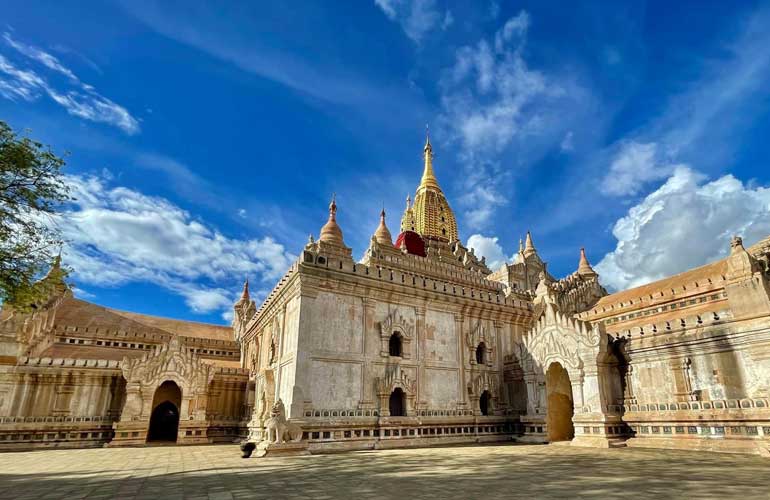
Ananda Temple Bagan
The downstairs of the temple is covered in 8688 gold leaves, while the upstairs is 13,153. The tower is decorated with 5488 diamonds, 2,317 rubies, sapphires, and other precious stones of various sizes. There’re 1,065 gold rings, particularly fitted atop a 76-carat diamond. The total gold inlaid on the temple is estimated at 60 tons, Burmese are very proud and have stated that: the gold glows so brightly that it can be seen throughout the city of Yangon.
The residents, as well as visitors, often come to burn incense in the sunset, then admire the temple until dark. Their last job before leaving is to light up the candles around the temples to pray for peace. They absolutely believe in the sacredness of the temple since it retains eight hairs of the Buddha Shakyamuni.
For centuries, Burmese have sought peace for their family by giving gold and ornaments to the temple. Many people prefer to buy thin gold leaves and then directly apply them to Buddha statues. In Mahamuni Paya temple, after a long time of getting gold leaves from residents and tourists, the gold was so thick that the original Buddha statues become formless.
Each temple contains its own unique and mysterious value, so visitors are always excited to discover it even though there’re many continuous temples in the itinerary.
Visitors will explore the Buddhist book made from the 729 marble slabs at Kuthodaw temple.
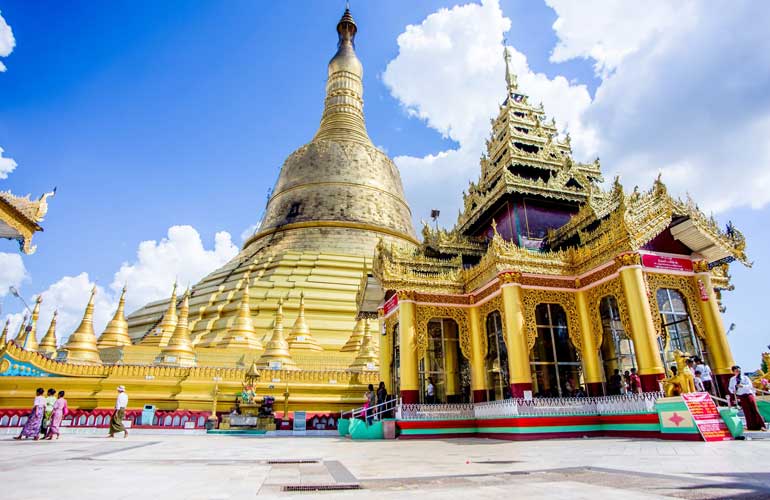
Shwemawdaw Paya
In Golden Rock Pagoda, it will take time for visitors to erase the amazing feeling of the magnificent golden rock and the temple built over 2,500 years ago. The temple stands on a protruding cliff which is over 1,700 meters altitude.
According to legend, before entering nirvana, the Buddha went through here. Having been enlightened, a monk was dedicated to practicing Buddhism. With his strength and the relay of Buddha, the monk moved the hundred-of-ton stones from the sea to build on it a metal stupa. It is the Golden Rock of today.
At the first glance, I - like many other tourists – thought that the rock and the temple might collapse at any time...
Unique lifestyle
That is the lifestyle of the Intha, an ethnic group in Myanmar. All of their activities take place on Inle lake.
People build houses on stilts, go fishing and grow vegetables on the lake and bring them to floating markets.
The floating gardens with great rows of vegetables and trees laden with fruit make visitors fascinated and admired their creativity.

Activities of people in Inle Lake
Floating gardens were created by taking knitting hyacinth roots to form the bottom layer. The next layer is woven together with seaweed. And the top layer is soil that was brought from shore. Then, they used thousands to tens of thousands of bamboo poles holding on to the gardens.
Although floating, each bed of vegetables is consistently ranked, and between the rows, is a distance that is enough for only a boat to go taking care of and harvesting sediment of the lake is the main source of nutrients to feed vegetables. They do not use chemical fertilizers or pesticides, so the sun-ripened tomatoes though small but sweeten naturally.
The Intha are known for their unique way of rowing with one leg. When witnessing this image, you can see their excellent skill. Whether standing on the floating boat, they still keep the balance on one leg while the other leg and both hands are always working.
The Intha also weave colorful silk. In particular, they produce a special fabric from the body of the lotus, probably, this is the most unique material in the world.
It takes 8,000 lotus stalks to weave a 0.6m-wide and 2-m-long fabric. Many visitors did not regret paying USD 200 for a small tablecloth woven from lotus silk as a souvenir.
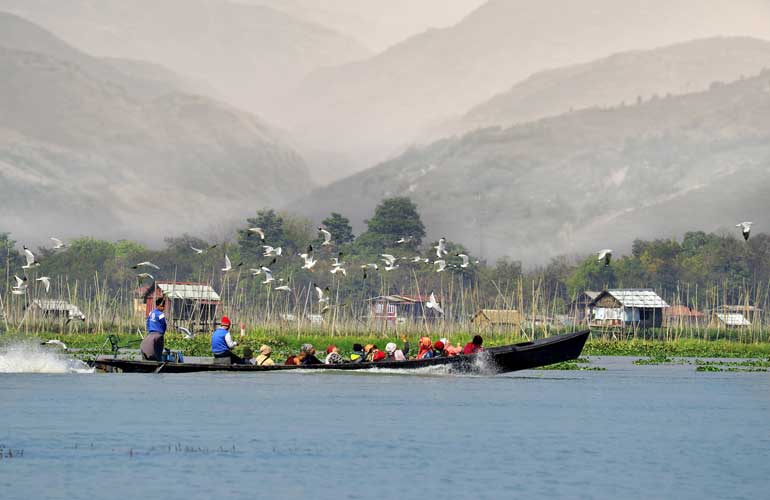
Explore the Inle Lake
In addition, the craft of blacksmiths producing knives, hammers, and swords ... still exists in the village of Inle Lake. Hand-made tobacco that appeared over 100 years ago still exists and even is the main way to earn a living for many families. The way is taking medium leaves (not too old, not too young) to wrap minced dried tobacco leaves.
The top of the cigarettes is wrapped in corn husks. Male smokers never overlook the opportunity to enjoy it. They were all satisfied and commented: simple but very tasty ...
Tea and cakes in Myanmar
Burmese especially like different kinds of cake, from sweet to savory. In any public teahouse in Myanmar, you may also see various kinds of cakes on the table to enjoy with hot tea.
In addition to traditional dishes like grilled fish wrapped in banana leaves nga baung doke, grilled chicken year Susie kyaw, salad lappet think which greens are fresh tea leaves, noodles fish Mohinga for breakfast on special occasions, and a lot of curries cooked with seafood, pork, chicken, lamb ... The Burmese especially like different kinds of bread, from sweet to salty.

Tea and Cake in Myanmar
Most of the cakes in Myanmar are made from rice flour. With salty cakes, people often mixed with minced onions, garlic, and ginger, so they will be fragrant when baking or frying. It can also be mixed with coconut fiber, tomatoes, sesame seeds, and curry powder ... to make different kinds of cakes.
Also, there are many types of donuts that are similar, even very close to their brothers in Vietnam, such as oranges bread in the South and sweet green bean donuts in the North ... Those normal pastries will be served with raisins or walnuts in luxurious restaurants.